
Oroklini: Larnaca's Village Suburb by the Sea

Oroklini works best as a quiet base for Larnaca rather than a destination in its own right: a village suburb about 7–10 km north-east of the city, split between a hillside settlement and a coastal strip closer to the sea. Plan on using it for a park walk, a viewpoint and easy access into Larnaca, and treat the village itself as somewhere to sleep and eat rather than somewhere to sightsee all day.
This guide covers where the two halves sit, who the area suits, the park loop with its distance and ascent, and how the buses and roads connect you to Larnaca, the airport and Nicosia. It also flags the practical points that catch visitors out: the proximity of the UK base boundary and the buffer zone, the need to carry a passport, and hire-car cover if you plan to drive beyond the Republic.
What Oroklini is and where it sits
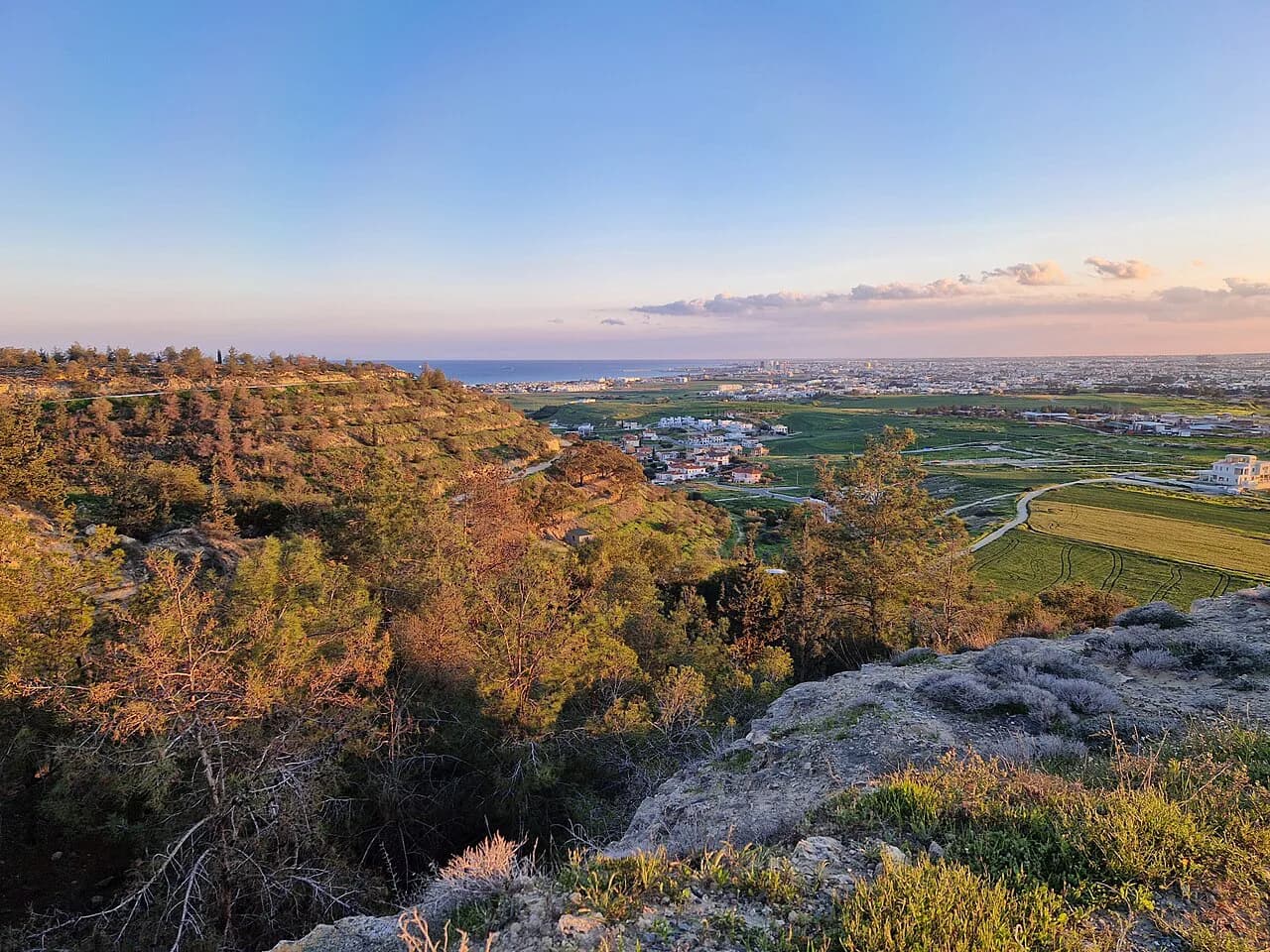
Oroklini lies north-east of Larnaca on the road towards the Dhekelia base and Ayia Napa, and a significant part of it sits outside the Larnaca beltway, with a smaller part inside it right on the seashore. That layout explains the two halves visitors notice: an inland village on rising ground and a coastal strip that feels closer to the sea.
The name appears in English as both Oroklini and Voroklini, and the Greek forms include Ορόκλινη and Βορόκληνη; the spelling Oroklini is the one you will see on most signs and maps. The distance into Larnaca is about 7–10 km depending on which part of the village you stay in, while the centre of Nicosia is roughly 50 km away.
That position makes Oroklini one of the closest coastal villages to Nicosia on the Republic side, and it also puts Ayia Napa within reasonable reach by car or bus. If you want to compare it with other bases around the city, the Larnaca Neighborhoods: 5 Area Guides sets out how the alternatives differ.

Who Oroklini suits and who it does not
Oroklini suits travellers who want a calm, residential base with a car or a willingness to use buses, and who value being close to Larnaca without paying for a central location. It does not suit anyone who wants to step out of the door into a town centre, a promenade or a dense cluster of restaurants, because the village is spread out and the two halves are separated by the highway.
If your priority is walking to the seafront, cafés and the marina, a central Larnaca district is the better fit, and Finikoudes puts you on the seafront promenade with the main city amenities on the doorstep. Oroklini is the opposite trade-off: quieter surroundings at the cost of a bus or drive for most evenings out.
Travellers heading south of the city instead should look at Pervolia, which sits on the coast beyond Larnaca towards Kiti and has a very different, lower-key character. Comparing those two villages is the quickest way to decide which side of Larnaca you want to be on.

The village and the coast: which half you will use
The two halves serve different purposes: the coastal side is where the bus into Larnaca runs and where the seafront strip inside the beltway sits, while the hillside village is the more residential half, with the older settlement pattern and the everyday shops, and it is where you will find the quiet streets that give the area its character.
The split matters for planning: if you book accommodation on the coastal strip you can manage without a car, using the bus for the city, while a hillside base is more comfortable with a hire car for shopping, eating out and getting to the beach. Check the exact location of any accommodation against the highway before booking, because the two halves are not comfortably walkable to each other.
For a broader sense of what the city offers once you arrive, the things to do in Larnaca guide covers the seafront, the historic core and the main sights within the municipality. It is a useful complement to a village base, since Oroklini itself has little in the way of formal sightseeing beyond the park.
Oroklini Park and viewpoint
The main reason to build time into Oroklini rather than treating it purely as a bed base is the park and viewpoint in the area. Trail data lists the Oroklini Park and view point route as a moderate 4-mile loop (about 6.4 km) with roughly 610 ft of ascent, taking about 1.5–2 hours to complete.
Treat those figures as trail data rather than an official park notice, and judge them against the season: the ascent is modest but the ground is exposed, so the same loop that takes an hour and a half in spring will feel considerably harder in high summer. Start early, carry water and avoid the middle of the day between June and September.
The payoff is the view from the point over the surrounding area and the plain towards Larnaca, which is a better use of an hour than driving into the city for a similar panorama. Walkers wanting more serious ground should look to the Troodos rather than to this low hill.
Getting to Larnaca, the airport and Nicosia
From the coastal area of Oroklini there is a bus every 15–20 minutes to Larnaca city centre and the airport, which is the pattern that makes a car-free stay feasible. Treat that as the described frequency rather than a timetable: confirm the current route numbers and times with the operator before you rely on a late or early service.
For Nicosia you first need to reach Larnaca city centre and pick up an intercity connection from there, so allow for the change rather than expecting a direct village-to-capital service. The same applies to longer trips along the coast: Larnaca is the hub, and Oroklini is a spoke off it.
Once in the city, the Finikoudes Larnaca seafront is the natural orientation point for onward buses, taxis and the main concentration of services. The Larnaca Attractions: 11 Visitor Guides covers what is worth adding to a city day if you are combining it with a village stay.
Getting around without a car, and what a hire car buys you
Without a car you can live in Oroklini, but it takes planning: the bus handles Larnaca and the airport, while beaches, the hillside village and evening restaurants are less convenient. A hire car buys you flexibility for the park, for shopping and for reaching the quieter stretches of coast, at the cost of parking and a designated driver.
Cyprus drives on the left and the Republic uses the euro, so a car collected at Larnaca airport will feel familiar to drivers from the UK and Ireland. If you are staying in the coastal strip, check whether your accommodation has parking before you book a car, since street parking in the village halves is limited.
For comparison, Mackenzie Larnaca shows what a city-edge district with a beach looks like if you decide a car-free stay matters more than quiet. It is a different proposition from a village suburb, and the contrast helps you pick the right base.
The Pyla and Dhekelia context
Oroklini sits about two kilometres from the boundary of the UK base area at Dhekelia and roughly three kilometres from the buffer zone, close to military land. The base area contains ordinary villages and farmland, and the buffer zone runs through the nearby village of Pyla, where Greek Cypriot and Turkish Cypriot communities live side by side.
Practically, that means carrying your passport when you drive east of Oroklini, and checking with your hire-car company whether your insurance covers the areas you intend to visit before you set off. Crossing points on the Green Line have their own rules, and driving a Republic-registered hire car into the north is a separate question from walking across.
None of this is a reason to avoid the area: the base boundary and the buffer zone are part of the everyday landscape here, and Pyla is worth a look for its unusual arrangement. Just plan the paperwork rather than discovering it at a checkpoint.
Practical points for a stay in Oroklini
The Republic of Cyprus uses the euro, so budget in euros for buses, cafés and any entrance fees you encounter in Larnaca; Cyprus drives on the left, and the roads around the village are straightforward outside the highway junction. Summer heat is the main practical constraint, with exposed ground around the park and the coastal strip offering little shade in the middle of the day.
The village is a residential place rather than a resort, so expect quieter evenings and fewer facilities than the city districts, and plan your meals and shopping accordingly. If you want a base with more going on outside the door, Skala Larnaca is the livelier alternative near the city's historic core.
Should you base yourself in Oroklini?
Choose Oroklini if you want a quiet, spread-out base with a genuine hill walk on the doorstep and a frequent bus into Larnaca from the coastal strip. Skip it if you want to walk to a promenade or a choice of restaurants in the evening without getting in a car or on a bus.
The sensible plan is to pair it with the city rather than treat it as a standalone destination: use the village for sleeping and the park for an early walk, then take the bus into Larnaca for the seafront and the sights. Confirm current bus times and any hire-car insurance conditions directly with the operator and rental company before you travel.
Frequently Asked Questions
Where exactly is Oroklini in relation to Larnaca?
Oroklini lies north-east of Larnaca, on the road towards the Dhekelia base and Ayia Napa. It is roughly 7–10 km from Larnaca depending on which part of the village you are in, and about 50 km from Nicosia. Part of the village sits outside the Larnaca beltway and a smaller part inside it, close to the sea.
Can you stay in Oroklini without a car?
Yes, if you stay on the coastal strip, where the bus into Larnaca city centre and the airport runs frequently. The hillside village is less convenient without a car, and reaching beaches or evening restaurants will usually mean a bus, a taxi or a lift. Check current route numbers and times with the bus operator before relying on a particular service.
How hard is the Oroklini Park and viewpoint walk?
Trail data lists it as a moderate 4-mile loop, about 6.4 km, with roughly 610 ft of ascent and a typical time of 1.5–2 hours. The ground is exposed, so it is best done early in the day in summer. Treat the figures as trail data and judge them against your own fitness and the heat.