
Amathus Archaeological Site: A Visitor's Guide to Ancient Amathous

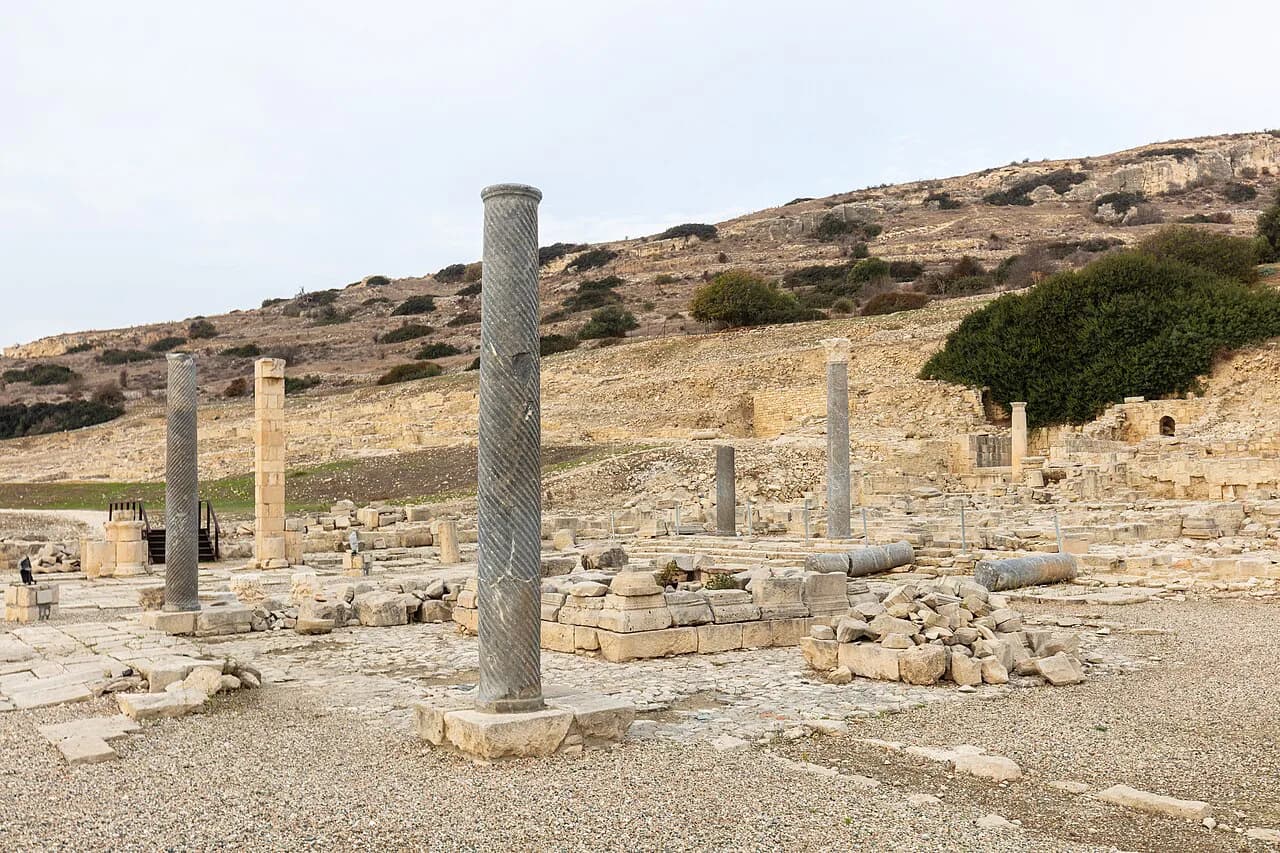
Give Amathus two hours, or three if you want the lower city and the harbour as well as the hill. It is an Iron Age city-kingdom spread over a coastal hill about 10 km east of Limassol, occupied from roughly 1050 BC until about AD 700, and the visit splits cleanly between the exposed summit and the excavated ground below. This guide covers where it sits, how to reach it, what stands on the acropolis and in the lower city, and how long each part takes.
What Amathus actually was
Amathus was the capital of one of Cyprus's Iron Age kingdoms, founded on an empty site in the 11th century BC and lived in until the end of the 7th century AD. That makes it a different proposition from a Bronze Age site: its story begins after the collapse of the island's Late Bronze Age palaces, and its rulers kept a distinct identity for centuries. For a visitor, the payoff is a compact hilltop with stratified layers rather than a single showpiece monument.
The people of Amathus held on to Eteocypriot, the island's older non-Greek language, at least until the time of Alexander the Great. It is one of the details that makes the site worth more than a quick photo stop: you are looking at a kingdom that resisted the Greek cultural mainstream longer than most. Keep that in mind as you read the labels on the summit.

Where the site sits
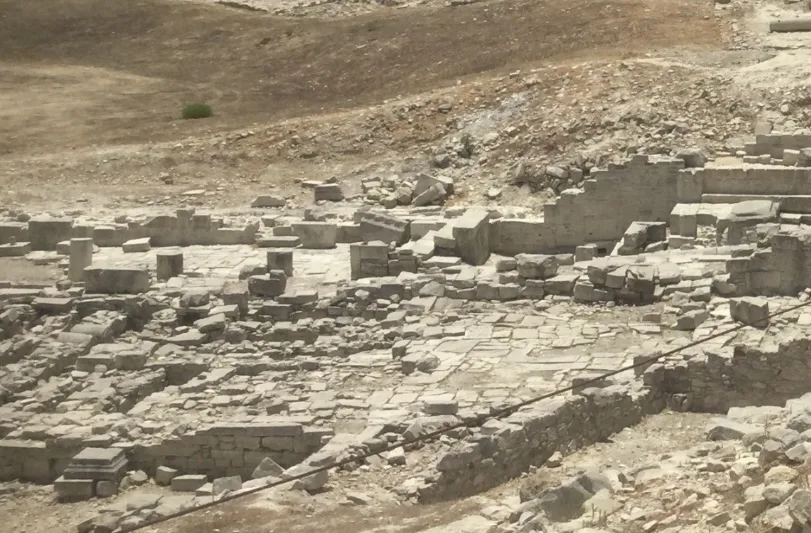
The acropolis is a small coastal hill reaching 88 m above sea level, in the Limassol district near Agios Tychonas, with the excavated lower city and the bay spread out beneath it. Because the hill is modest, the walk up is short but steady, and the view back over the lower city is one of the reasons to make the climb rather than viewing from the road.
The site is often described simply as Amathus or Amathous, and older plans sometimes label it under Agios Tychonas or Ayios Tychonas. If your map app struggles with the ancient name, the coastal position around 34.712° N, 33.142° E puts you in the right place.

Getting there from Limassol and beyond
By car, Amathus is a short run east of Limassol along the coastal road towards Agios Tychonas, which suits anyone combining it with other stops in the district on the same day. Cyprus drives on the left, and the approach road and car park arrangements are the sort of thing to confirm locally rather than assume. Bus services along this stretch of coast do exist, but routes and timetables change, so check the current Limassol urban bus information before relying on one.
Parking charges, bus fares and journey times are not worth guessing at; check them when you plan the day. If you are working out how Amathus fits with the rest of the district, the wider set of Limassol Attractions: 10 Visitor Guides is a sensible place to start, since it groups the castle, the archaeological sites and the town centre in one view.
The acropolis: palace, sanctuary and Roman temple
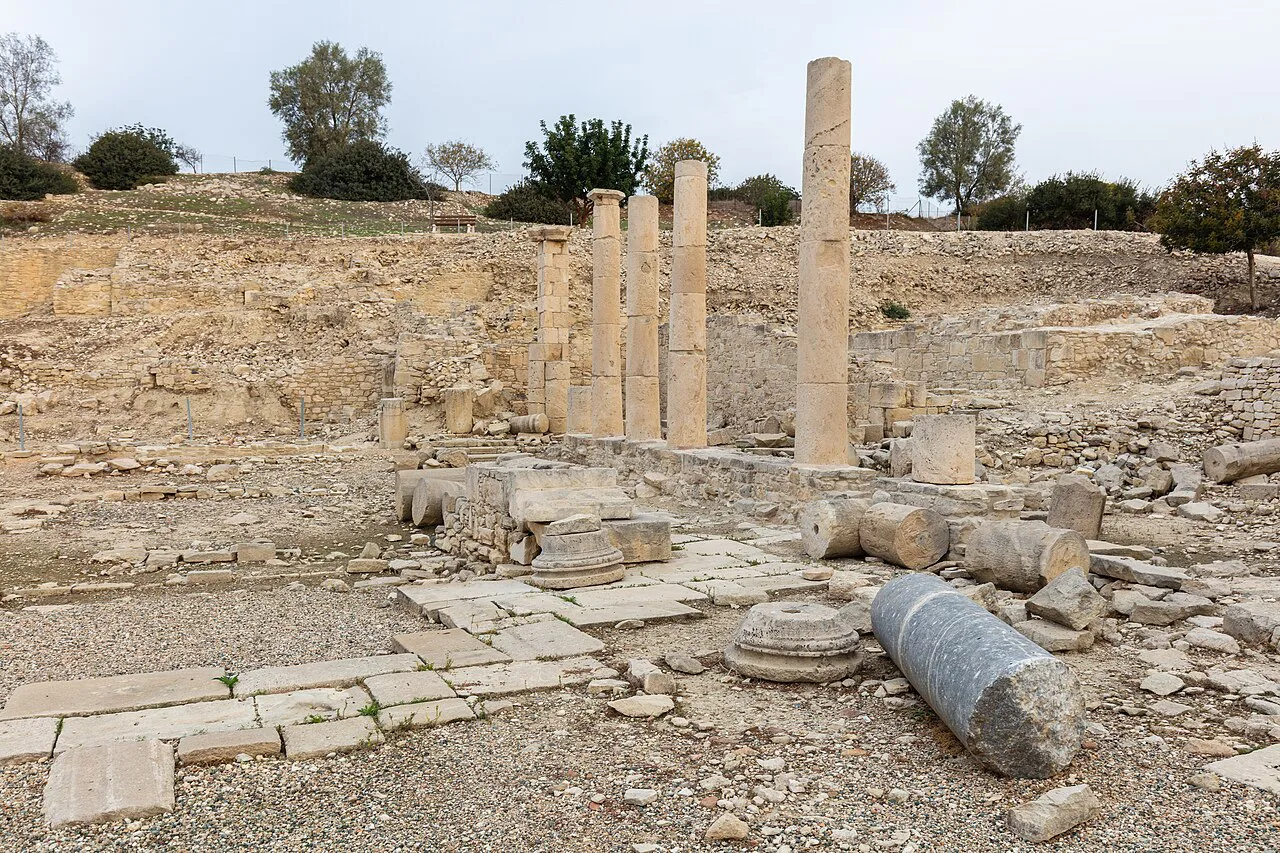
The summit carried the Kings' palace and a sanctuary of Aphrodite, and later a temple of the Roman period. The last recorded king is Androkles, in the late 4th century BC, which gives the palace remains a specific date to anchor to rather than a vague ancientness. Read the plan before you walk it: the sanctuary and palace are the reason the hill was chosen, and knowing which outline is which changes what you see.
Excavation on the hill has been led by the French School at Athens from 1975, covering the acropolis, the walls and the territory. That long campaign is why the summit reads as a sequence of building phases rather than a tidy ruin, and it also explains the fragments of roof tiles and fallen stone you will notice across the surface.
The stone vases and the Christian complex
Two features on the summit are easy to overlook. The great stone vases are among the site's distinctive survivals, cut from stone rather than clay, and a Christian complex was later built on the same high ground, showing the hill was never simply abandoned between phases. Look for both on the way round; they are the details that make the acropolis more than a set of wall lines.
The lower city, walls and harbour
Below the hill, the lower city was excavated by M. Loulloupis for the Department of Antiquities between 1976 and 1991, and the city walls formed part of the French School's work. The harbour is the detail most short descriptions skip: it measured about 100 by 180 m and was built at the very end of the 4th century BC. Seeing the harbour means leaving the summit and walking down, which is where your extra hour goes.
The cemeteries and the built tombs at Loures
Amathus is as much a site of tombs as of temples. The cemeteries were dug by L. P. di Cesnola in 1874–1875, by the British Museum on the Turner Bequest in 1893–1894, and by the Swedish Cyprus Expedition in 1930, with rescue work from the late 1970s and built tombs at Loures excavated from 2009. If you have an hour to spare and an interest in burial architecture, the tombs explain how the city's people were laid out beyond the walls.
How long to allow, and pacing it in the heat
Plan on 90 minutes for the acropolis and the labels on the summit, and up to three hours if you add the lower city, the walls and the harbour. The hill is only 88 m high, but much of it is exposed open ground, so a summer visit is better early or late in the day than at midday. Carry your own water and supplies for the climb, as you would on any exposed archaeological site.
Pairs well with a longer half-day: the ruins can be seen from the bay side as well as from the summit, so allow time on the lower ground as well as the hill. If you are travelling with someone who would rather not climb, they can wait on the flat while you do the summit loop.
Tickets, hours and closed days
Amathus is a Department of Antiquities site, and opening hours and ticket prices are set by the Department and vary by season, so confirm them before you travel rather than trusting an old figure. The same applies to closed days, which are not the same across all Cypriot sites. Kolossi Castle, inland near Kolossi village, is another state-run site, so check its published hours via the Limassol Attractions: 10 Visitor Guides page before you plan a combined day.
Where the finds ended up
Objects from Amathus are held in the Limassol District Archaeological Museum, and further afield in the Louvre, the British Museum and the Metropolitan Museum. That dispersal is a legacy of the 19th- and early 20th-century digging, including Cesnola's cemetery work in the 1870s. If you want to see the material rather than the ruins, the Limassol district museum is the logical first stop.
What to pair with Amathus nearby
Amathus sits in a cluster of Limassol district archaeology. The Kourion Archaeological Site and, a short drive beyond it, the Sanctuary of Apollo Hylates make the obvious extension for anyone with a full day and a car. Together they let you compare a city-kingdom with a major sanctuary and a Roman town in the same trip.
In Limassol itself, the compact old town is easy to add afterwards: Limassol castle, the old harbour and the Agia Napa cathedral Limassol all sit within walking distance of each other around the centre. That makes a natural second half-day once you have done the coast road east.
Is Amathus worth the climb?
Yes, if you want the harbour and the lower city as well as the view; no, if you only have time for one archaeological stop and want the showier site. Amathus rewards a reader who is interested in the kingdom's unusual identity, its Eteocypriot language and its long occupation, and it is compact enough to fit around other stops. Check the Department of Antiquities for the day's opening hours before you set out.
Explore more Limassol guides
Frequently Asked Questions
Where is Amathus?
Amathus sits on the coast of the Limassol district, about 10 km east of Limassol and close to Agios Tychonas, with the excavated lower city and the bay spread below the 88 m acropolis hill. The approximate coordinates are 34.712° N, 33.142° E, which is handy if your map app does not recognise the ancient name.
What other names is Amathus known by?
The site is recorded under several forms, including Amathous, Amathonte and Ayios Tychonas, and its people spoke Eteocypriot, a non-Greek language, into the time of Alexander. Those are alternative names and a language detail, not a translation of the word Amathus.
Do I need a car to visit Amathus?
A car is the simplest way to combine Amathus with Kourion and the Sanctuary of Apollo Hylates, since they sit along the same stretch of the Limassol district. Buses run along the coast but routes and timetables change, so check the current Limassol bus information before you rely on one.