
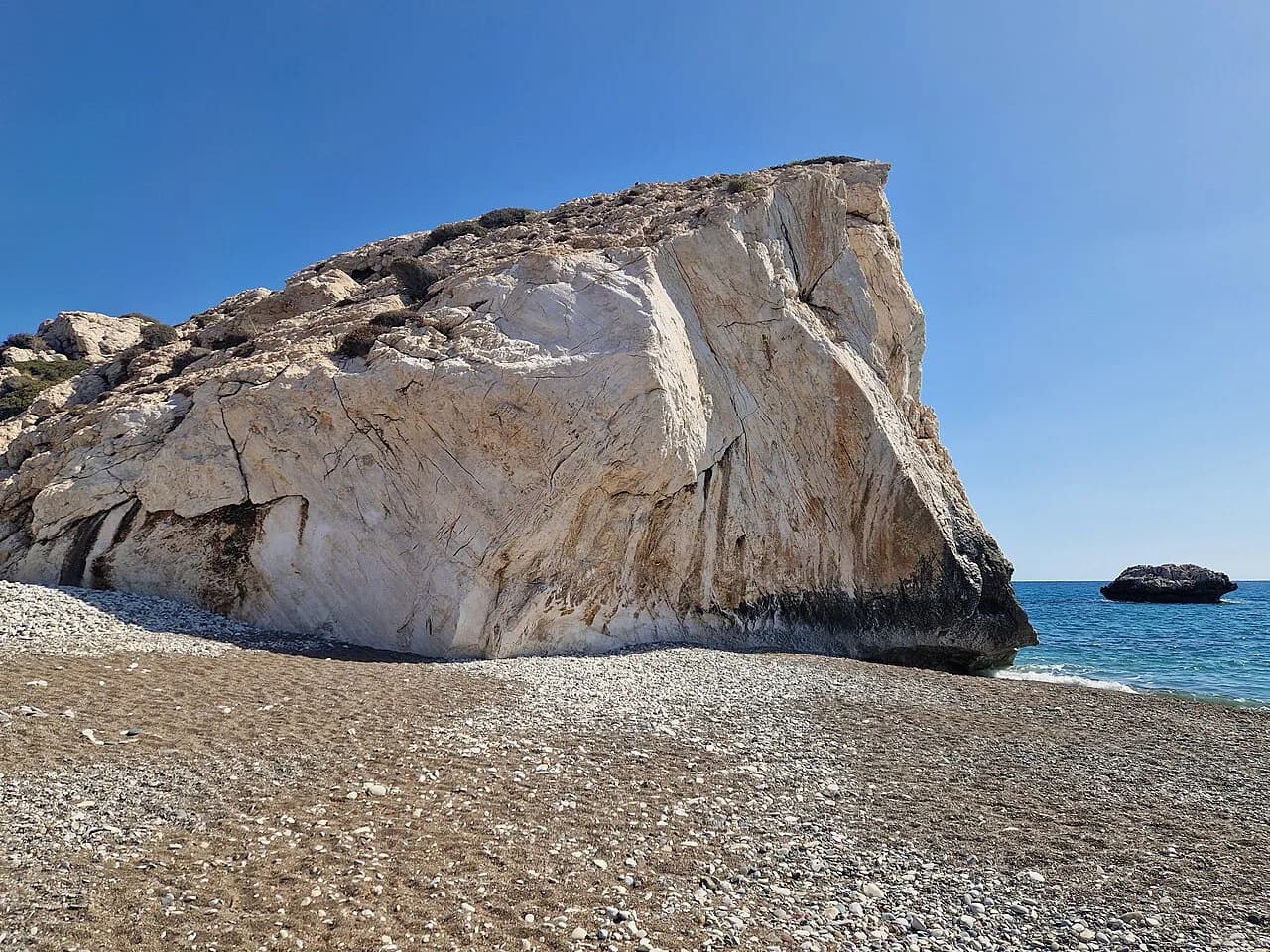
Aphrodite's Rock (Petra tou Romiou): How to Visit

Aphrodite's Rock is worth a stop of roughly half an hour to an hour, and it earns a longer visit only if you want to walk the coast or swim. The rock, Petra tou Romiou, is a sea stack on the southwest coast by Kouklia in Paphos district, a short detour off the Limassol–Paphos road. This guide covers what you see from the roadside and the beach, how to drive there, the legend, and the sights that make a half-day of it.
It suits travellers driving between Paphos and Limassol or heading for the hills, not a whole day on its own. Kouklia village, with the Sanctuary of Aphrodite at Palaipafos, sits just inland, and Agios Neophytos Monastery is a worthwhile second stop if you want a ticketed sight with frescoes and a museum.
What Aphrodite's Rock is and where it sits
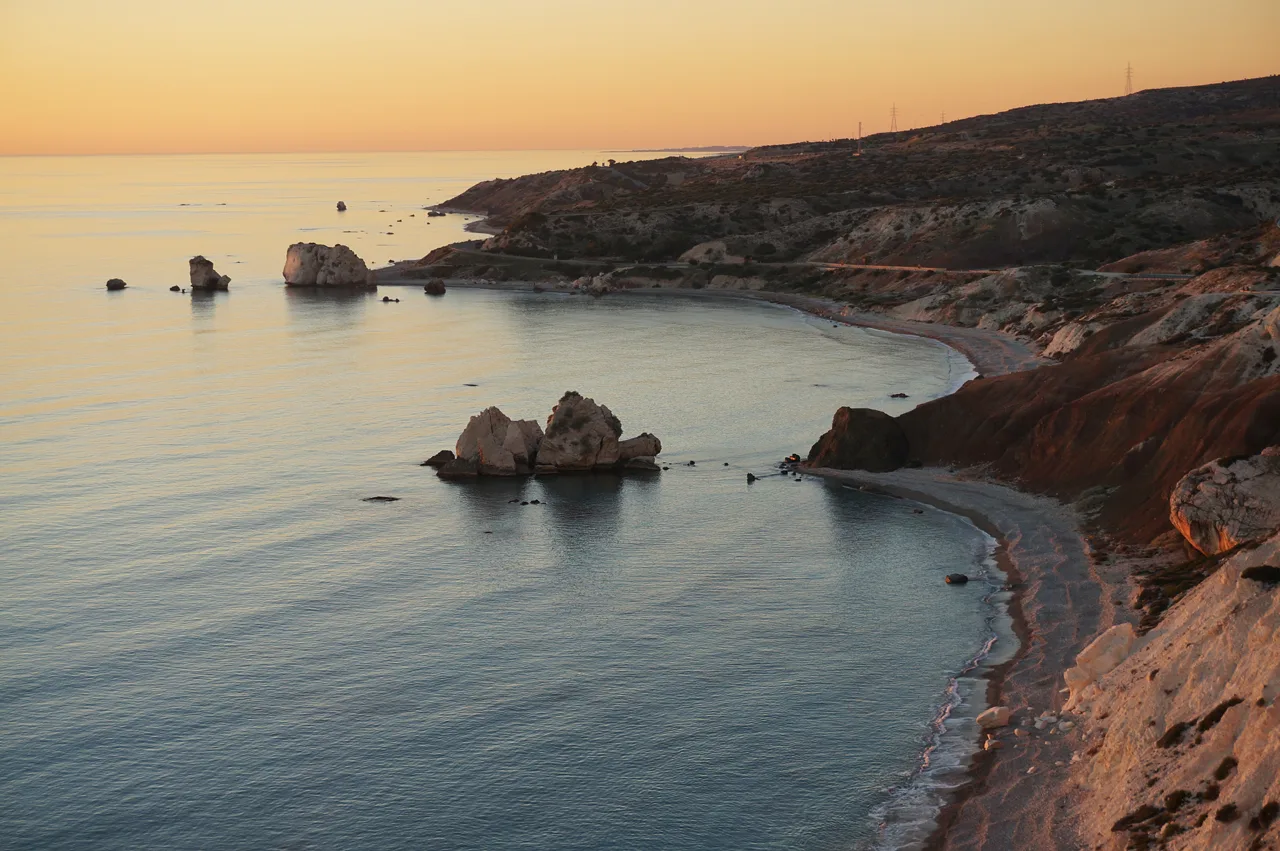
The rock itself is a single stack standing in the sea, and the coast around it is the draw: a curving stretch of shoreline with the rock offshore and the coastal road running behind. The village of Kouklia, which sits on the site of ancient Palaipafos, is 16 km from Paphos town and is reached by turning into the F616 route from either the B06 or the A06, the Limassol–Paphos highway.
Kouklia is built at 85 metres above sea level and looks down over the coastal shelf where the rock stands. The rock marks, in legend, the spot where Aphrodite was born from the foam, and it is that association rather than any structure on site that brings people. The archaeology is at Palaipafos inland, not at the rock itself.
Treat the stop as a roadside viewpoint rather than a destination with its own address. The rock is passed on the coastal road, and drivers heading for Kouklia should follow the F616 turn-off from the B06 or A06.

The myth: Aphrodite's birthplace and the swim legend
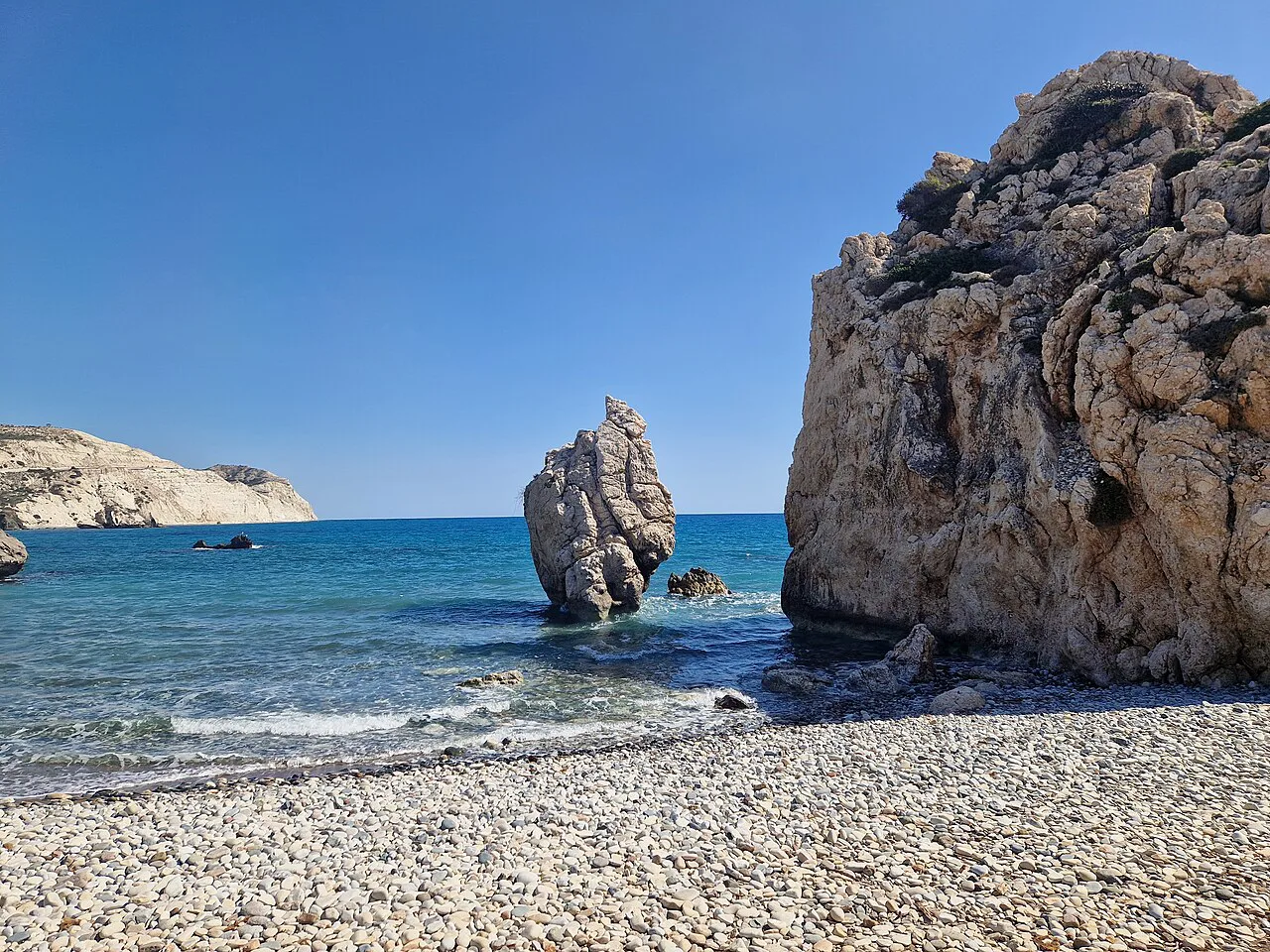
The story attaches two things to this coast: the birth of Aphrodite from the sea foam, and a belief that swimming around the rock brings luck or beauty. Treat the second as folklore. There is no ritual count and no official route attached to it, and you will hear different versions from different people.
The rock also carries the name Petra tou Romiou, the Rock of the Greek, and the two names are used interchangeably on road signs and in guidebooks. Knowing both helps when you search for directions or ask locally.

How to get there by car
Driving is the straightforward way. From Paphos town, Kouklia is 16 km via the F616 off the B06 or A06, and from Limassol you join the same corridor on the A06 highway. The rock comes into view from the coastal road before you reach the beach side.
Allow a comfortable margin for the exit, since this is a fast coastal corridor. If you are staying in Paphos without a car, organised excursions often take in the rock, or you can fill a day closer to base with things to do in Paphos that need no drive.
Cyprus drives on the left and the Republic uses the euro, so fuel and any roadside spending are in euros. Fill up before leaving Paphos or Limassol rather than relying on services beside the rock.
What you actually see: the viewpoint and the beach
There are two ways to experience the site, and most people do both in under an hour. The first is the roadside view, where the stack sits offshore against open sea and the coast curves away on either side. The second is the beach below, reached on foot, where you get the rock at eye level and can walk the shoreline.
This is an exposed coastal beach rather than a resort beach, and the draw is the setting and the legend, not loungers and shade. Come prepared to walk on pebbles and to stand in the sun, and bring water if you plan to stay beyond a quick look.
Photographers do best early or late, when the rock is side-lit and the coast is quieter. Stopping is a matter of finding a safe place to pull in rather than an official gate.
Can you swim at Aphrodite's Rock?
People do swim here, but the coast is open sea and the beach shelves from pebbles, so it rewards a confident swimmer rather than a paddler. You are swimming from an unmanaged stretch of coast; check conditions and your own ability before going in.
Judge the water on the day rather than on a guidebook. If the sea looks rough or you are unsure of your ability, the roadside viewpoint gives you the same view without getting wet.
How long to allow and when to go
Budget 30 to 60 minutes for the viewpoint, the beach and photos. Add an hour or two if you are combining the rock with Kouklia village, and a half-day if you continue to the monastery at Agios Neophytos.
Summer midday is the least comfortable slot: the beach has no shade and the coast road bakes. Early morning and late afternoon are better for light, heat and crowds, and the rock draws coach groups in the middle of the day.
Treat the rock as an easy add-on to a driving day rather than a booked attraction. Check the weather on the day for wind and sea state, since the coast is exposed.
Nearby: Kouklia village and the Sanctuary of Aphrodite
Kouklia is the obvious pairing and the reason the rock makes sense as a half-day rather than a photo stop. The village sits on the site of ancient Palaipafos, and excavations have uncovered the Sanctuary of Pafia Aphrodite, the fortifications of Palaipafos, a barrow cemetery and many tombs. Several finds from the area are kept in the local village museum.
The village is leafy and grows fruit and other crops, and its name is thought to come from the Byzantine word for a cubicle, after officials who guarded the emperor's chambers. Among the churches, Panagia Hodegetria is a 13th-century cruciform church with 15th-century wall paintings, and the church of the Apostle and Evangelist Luke holds a large fair each 17 October.
A medieval sugar production centre from the Lusignan period also survives at Kouklia, one of three medieval cane mills on the island and one of the few in the Mediterranean to keep its functional elements. Add it to the village stop if industrial archaeology interests you.
Nearby: Agios Neophytos Monastery
Agios Neophytos is a good second stop if you want a ticketed sight near the rock. It lies about 9 km north of Paphos, near Tala, and was founded by the recluse and writer Neophytos in the second half of the 12th century in what was then a secluded valley.
The hermit carved a cave called the Enkleistra, covered in Byzantine frescoes from the 12th to the 15th centuries. The monastery has an ecclesiastical museum, and its later church holds Post-Byzantine icons from the 16th century. Museum and Enkleistra entry is €2, with hours of 09:00–13:00 and 14:00–18:00 daily from April to October, and 09:00–16:00 daily from November to March.
It closes on Christmas Day, New Year's Day, Green Monday, Greek Orthodox Easter Sunday and 15 August, and the published times and fee can change, so confirm before setting out. The monastery makes a natural loop with the rock and Kouklia on a single day's drive from Paphos.
Nearby: Panagia and Chrysorrogiatissa in the hills
If you want to turn the coast stop into a mountain day, head inland to Panagia, also called Pano Panagia, a village at 900 metres in the Paphos mountains on the edge of Paphos forest. It is about 35 minutes from Paphos International Airport and takes its name from the churches and monasteries dedicated to the Virgin Mary around it. Keep the rock and the hills as two separate outings if you also want time for a ticketed family stop such as Paphos Zoo, which fills an afternoon on its own.
The monastery of Panagia Chrysorrogiatissa sits about a mile and a half southwest of the village, and its treasury holds ancient icons, the oldest dated to the 14th century, along with crosses, Venetian glass chandeliers and vestments. Kykkos monastery lies further east through the forest.
This is a proper drive on mountain roads, not a quick detour, so give it its own afternoon. It works best as a separate outing from Paphos rather than bolted onto a rock stop.
Is Aphrodite's Rock worth the stop?
Yes, as a 30-to-60-minute roadside stop with the option of a swim, and as the anchor for a half-day in the Paphos hinterland. Combine it with Kouklia and the Sanctuary of Aphrodite, and add Agios Neophytos if you want a ticketed sight with frescoes and a museum.
Skip it only if you are short of time and staying in Kato Paphos, where the archaeological park, the castle, the harbour and the Tombs of the Kings fill a day without a drive.
Explore more Paphos guides
Frequently Asked Questions
How many times do you swim around Aphrodite's Rock?
There is no set number. The swim-around custom is folklore with several versions, and no authority prescribes a count or promises an outcome. Swim only if the sea is calm and you are a confident swimmer.
Can you visit Aphrodite's Rock without a car?
It is easiest by car, since the rock sits beside the coastal route to Kouklia. Organised excursions from the Paphos area often include it alongside other stops, which avoids driving the coastal corridor yourself.
Is there an entrance fee at Aphrodite's Rock?
Treat the rock as a free roadside stop rather than a ticketed attraction. Fuel and any nearby ticketed sight such as Agios Neophytos are separate costs in euros.