
Stavros tou Agiasmati: A Visitor's Guide to the Painted Church near Platanistasa

Stavros tou Agiasmati is worth a deliberate detour: a single-room painted church in the hills above Platanistasa whose wall paintings were completed in 1494 and which holds the most complete cycle of late 15th-century murals on the island. Entry is free but by appointment, so the visit needs a phone call rather than a spur-of-the-moment stop. This guide covers where the church stands, how to reach it, what to look at once the door is open and how to pair it with the other painted churches of the area.
What Stavros tou Agiasmati is and why it matters
This is a UNESCO World Heritage site, listed among the painted churches of the Troodos region, and it began life as a monastery church rather than a village chapel. The decoration was finished in 1494 according to an inscription, and the name comes from the Greek word for sanctified water, a spring or well near a church. In practical terms, that history means one small room dense with narrative painting rather than a complex of buildings.
Only traces of the monastic cells survive, to the south of the church, so set your expectations on the church itself and its setting among the hills. The building is still in use as a church, and a priest, Father Georgios Kourris, is the contact for visits. Think of it as a short, focused stop of real quality rather than a site you roam for hours.

Where the church stands: Platanistasa and the Pitsilia hills
Stavros tou Agiasmati sits in the Pitsilia area of the eastern Troodos, in Nicosia district, a short drive from the mountainous village of Platanistasa. The official tourism portal places it about 3km outside the village, on a hillside rather than in the village street. Treat that last stretch as a country lane drive, not a roadside pull-in on a main road.
Pitsilia is a scattered upland of terraced slopes and small villages, and driving between them takes longer than the map distances suggest. Allow for that when you plan, and navigate to the coordinates the portal gives for the church, latitude 34.979155 and longitude 33.047013, rather than village-level navigation that may drop you at the centre. If you are building a wider mountain itinerary, our guide to Troodos Attractions: 13 Visitor Guides helps you slot the church into a sensible loop of villages and viewpoints.
How to get there: driving from Nicosia and the Troodos villages
A hire car is the realistic way to reach the church, because the last few kilometres climb away from the village and public transport does not serve the site directly. Come with a full tank and a downloaded offline map, as upland phone signal can be patchy between villages. Cyprus drives on the left, and the final approach is a narrow rural road, so take the bends slowly and watch for oncoming farm vehicles.
From Nicosia, head into the eastern Troodos through the Pitsilia villages toward Platanistasa, and schedule the church as the first or last stop of a mountain day rather than a mid-afternoon add-on. The same district holds several of the painted churches inscribed on the UNESCO list, including Panagia tou Moutoulla, so a single loop can take in two or three in one outing. If you prefer a broader half-day beyond painted churches, Cedar Valley in the Troodos makes a contrasting open-air stop.
Access and opening: appointment-only entry
The church opens by appointment and operates all year round, closing on public holidays. It is free to enter. Because there are no fixed daily hours, the visit only works if you phone ahead: the official portal gives the church contact as +357 22 652090 or 99677216, and a tourism listing adds +357 22652562 with the instruction to ask for the custodian at the village coffee-shop in Platanistasa.
Ring a day or two before you travel and state your date and rough arrival time, then ring again on the morning if you are driving from another town. The Visit Cyprus listing states that the church is wheelchair accessible; the doorway and uneven ground are otherwise what you would expect of a rural church, so judge for yourself on arrival. Confirm current opening arrangements before you set out.
What to see inside the painted church
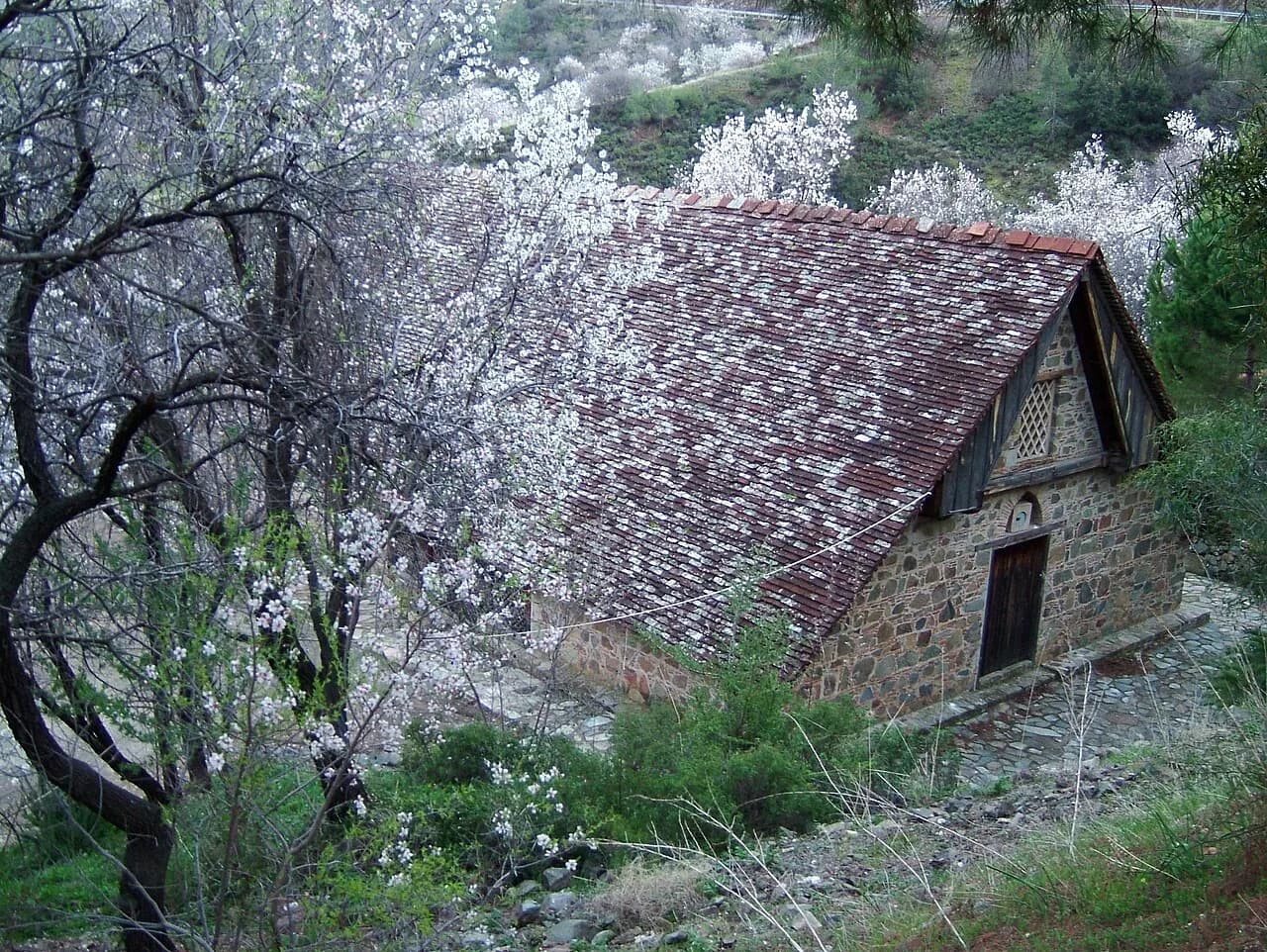
Start with the building itself. It is a single-aisled church with a steep-pitched timber roof covered in flat tiles, and the roof extends beyond the walls to create a portico on all four sides, a feature the official portal describes as unique in Cyprus. That wooden porch gives the exterior its distinctive long, low silhouette against the hillside and is the architectural reason the church photographs so differently from other painted churches on the island.
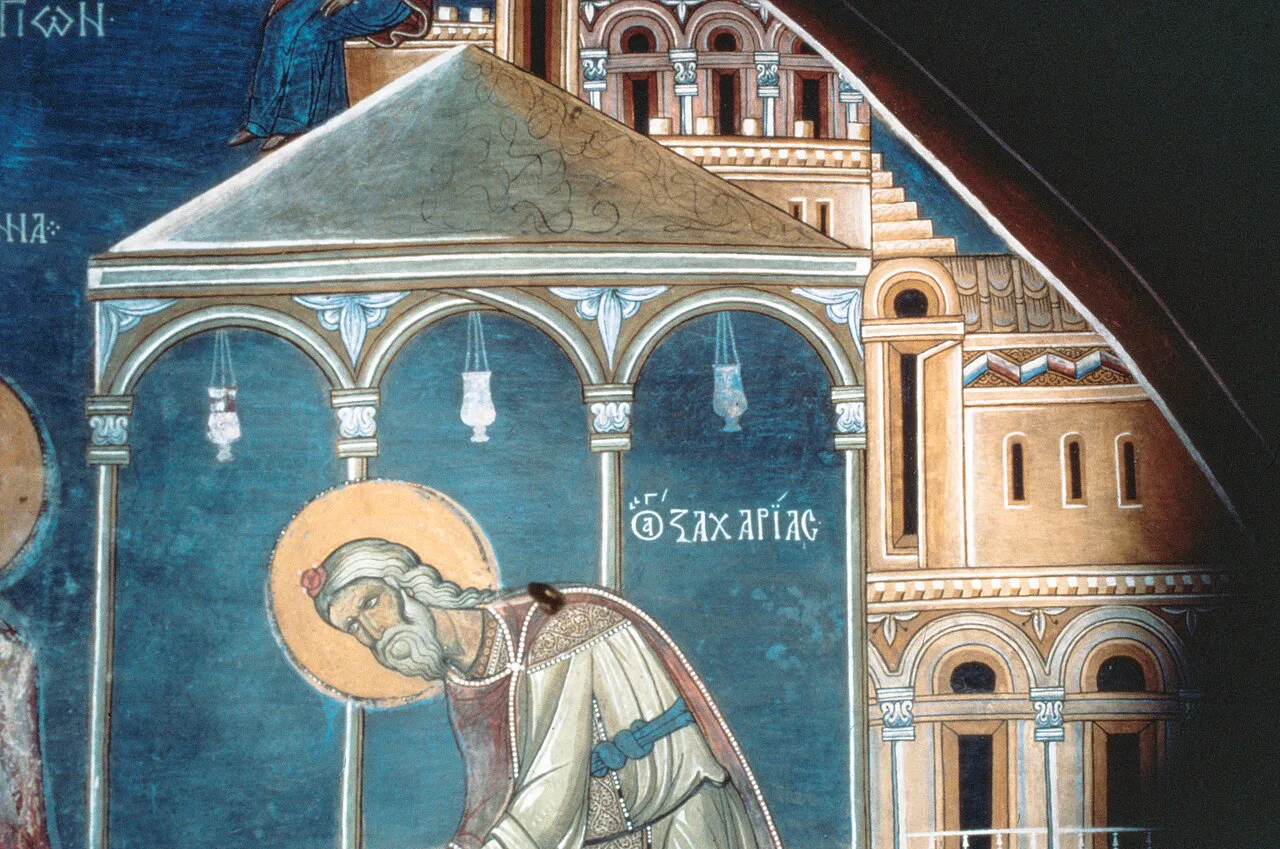
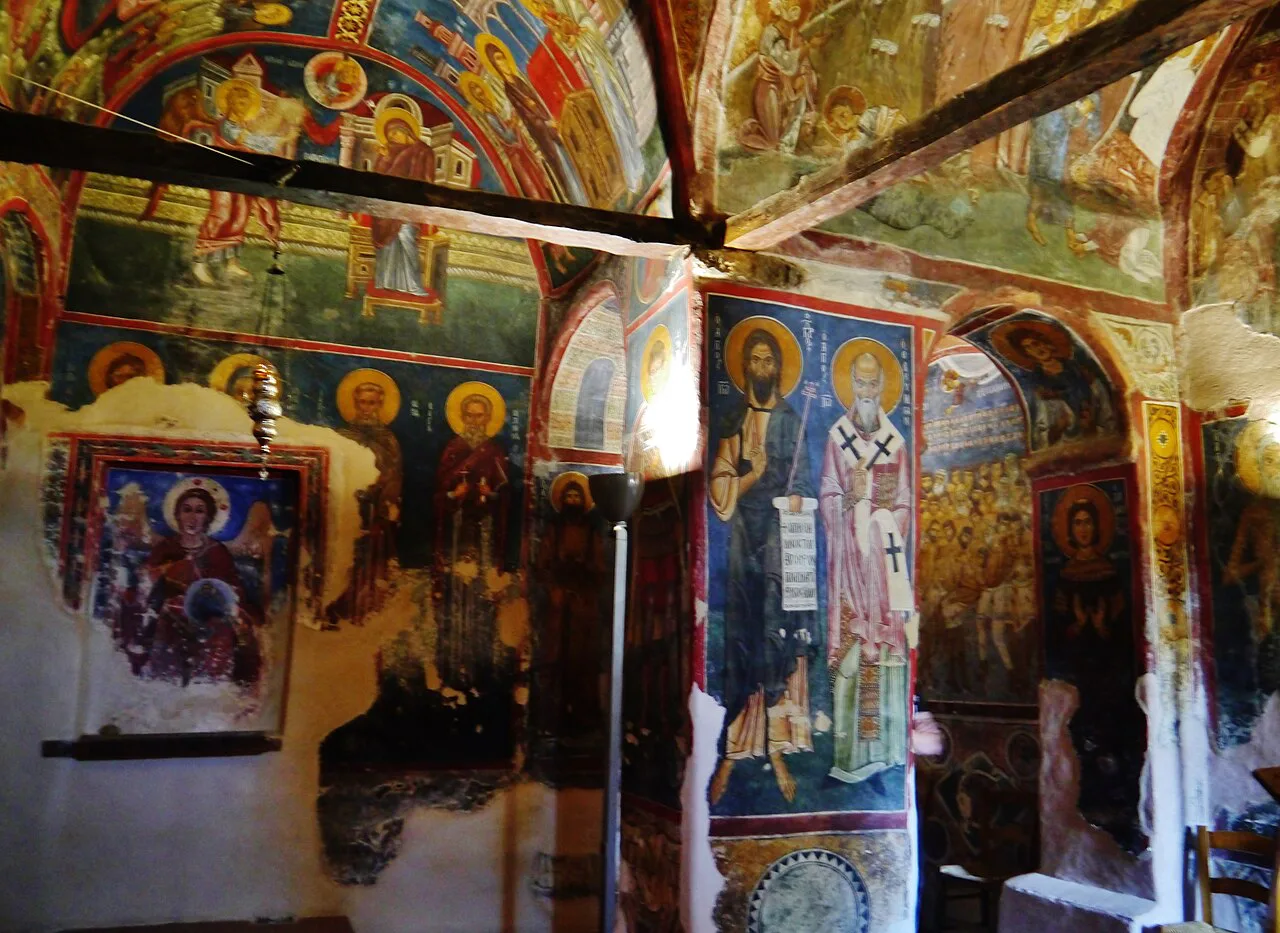
Inside, look first for the donor portrait: an inscription records that the building was paid for by a priest named Petros Peratis and his wife Pepani, who are shown offering a model of the church to Christ, with the Virgin mediating. It is the human key to the whole scheme, and spotting it makes the rest of the painting feel less anonymous.
Then give your time to the Last Judgment, an extensive multi-figure scene that climbs to the far end of the gable where Christ is depicted. Read it as a story moving across the wall rather than a single image, and step back toward the entrance to take in the whole composition before studying individual figures. The overall cycle is the most complete surviving programme of mural painting from the second half of the 15th century on the island.
How long to allow
Forty-five minutes to an hour inside and around the church is enough for most visitors, plus however long you spend on the drive from the village. Because entry is by appointment, the clock starts when the custodian or priest opens the door, so build in a buffer for a late arrival rather than squeezing the church between two fixed bookings.
Photography inside a painted church is limited by low light and by conserving the surfaces, so plan to look first and photograph second, without flash. If you are visiting in summer, the portico outside offers shade for a slow look at the exterior and a break before driving on. Keep the church stop compact and spend the rest of the day on the wider Troodos circuit.
Nearby: Panagia tou Araka and the walking link
Panagia tou Araka, one of the best-known painted churches of the area, sits within the same upland and makes the natural second stop of a two-church half-day. There is a signed walking route between Panagia tou Araka and Stavros tou Ayiasmati, measured at about 4.4 miles with roughly 846 feet of ascent and a time of two-and-a-half to three hours. That figure belongs to the trail, not to the visit, and it is a serious half-day in summer heat, so treat walking as an alternative to driving between the two rather than a casual add-on.
Other painted churches in the region reward a longer loop: Asinou church with its Panagia Phorbiotissa paintings, Agios Nikolaos tis Stegis in the Solea Valley, and Panagia Podithou in Galata. Our guide to Agios Ioannis Lampadistis in Kalopanayiotis covers another monastery church in the same tradition. Further west, Kykkos Monastery, also known as Panagia tou Kykkou, is a far busier visit with a very different atmosphere.
If you want variety beyond churches, the upland also offers short nature stops such as Millomeris waterfall near Pano Platres, Caledonia waterfall, and Chantara waterfall in Foini, plus the Troodos botanical garden in the national park. These are outdoor, weather-dependent stops, so save them for a clear day and keep the church as the anchor of the drive.

Practical points: heat, holidays and combining stops
The church closes on public holidays, so check the Cypriot holiday calendar before fixing your date and avoid a wasted mountain drive. In summer, upland Platanistasa is cooler than the coast but the sun is still strong at midday, and the drive involves narrow bends; an early start suits both the heat and the custodian arrangements.
Entry to the church itself is free, which makes it a low-cost anchor for a day that would otherwise be spent on fuel and coffee stops. Bring water and a layer for the shaded interior, and keep your phone charged for the calls that arrange access. Pair the visit with a village lunch in Platanistasa before or after the appointment rather than building the day around it.
Is Stavros tou Agiasmati worth the detour?
Yes, if you accept that the visit is arranged rather than simply turning up: one phone call, a short upland drive and an hour in a room of late 15th-century painting is a far better use of a Troodos morning than another village square. It suits travellers already touring the Pitsilia churches, less so anyone hoping for a quick roadside stop between Nicosia and the coast.
Build the day around a confirmed appointment, add Panagia tou Araka or another painted church nearby, and keep the rest of the itinerary loose for weather and road time. Confirm the appointment and holiday closures before you leave your base.