Makarios Tomb, Throni Hill: Visiting Above Kykkos Monastery
The tomb of Archbishop Makarios III sits on Throni Hill above Kykkos Monastery. What you see there, how the approach works and why the setting shapes the visit.
On this page
The tomb of Archbishop Makarios III, the first President of the Republic of Cyprus, stands on Throni Hill in the Troodos mountains, about 3 kilometres from Kykkos Monastery and roughly 1.2 miles (2 kilometres) above it. It is a small, dignified shrine rather than a grand mausoleum: a stone tomb under a domed canopy, mosaic detail and a colossal statue, set among pines. This guide covers what you actually see at the site, how it sits relative to the monastery, and how to combine the two without overestimating what is there.
What the Makarios tomb is and where it sits on Throni Hill
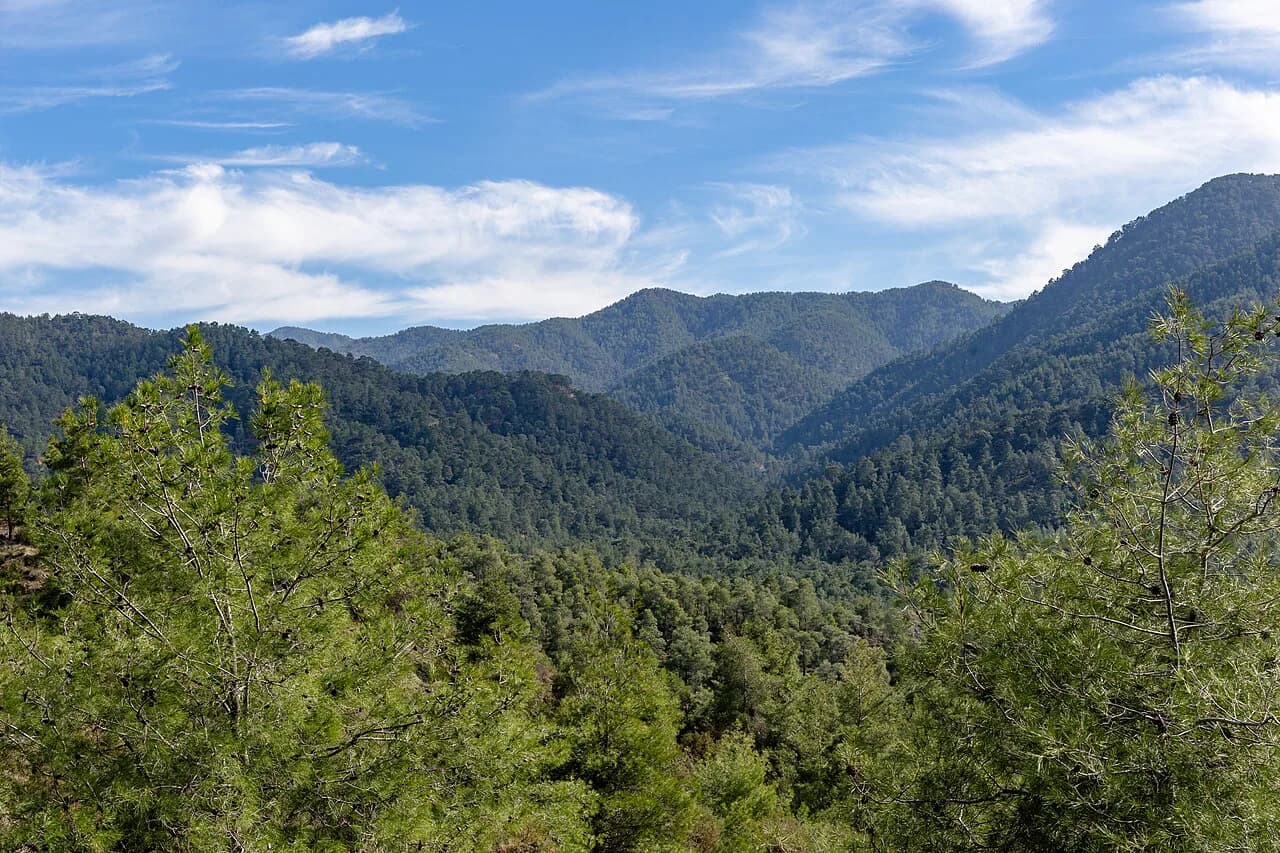
Throni Hill is a forested height in the Troodos range, and the tomb occupies a commanding, quiet position on it, surrounded by dense pine and looking out over mountain ridges. The approach is a gradual ascent along a paved pathway, so the last stretch is a walk rather than a drive to the door.
The tomb sits about 3 kilometres west of Panagia of Kykkos, the monastery dedicated to the Virgin Mary, which places it firmly in the Kykkos neighbourhood rather than on the main Troodos circuit. Treat the hill and the monastery as one outing, because the roads that reach one serve the other.
How to reach Throni Hill from Kykkos Monastery and the Troodos roads
The practical route is to drive to Kykkos Monastery first and continue up to the tomb from there, since the two are only a couple of kilometres apart on the same mountain road. Troodos roads climb, bend and narrow, so allow generous time rather than scheduling the hill tightly against a later stop. Mountain weather can close in quickly at this height, and the drive is the part of the day most likely to slow you down.
Because the tomb sits above the monastery rather than beside the car park, plan on a short walk at the end of the drive; the paved path rises gradually to the memorial. There are no ticket gates or timed entries to organise, so the visit fits around the monastery rather than the other way round. Confirm any seasonal access arrangements with the monastery before setting out, as this is one detail worth checking on the day.
What you see at the site: the tomb, the domed canopy and the mosaics
At the centre of the site is the simple stone tomb of Makarios, sheltered beneath a small domed canopy. The structure is deliberately restrained, with Byzantine-inspired detail and mosaic decoration and Orthodox Christian symbolism that recall his dual role as religious leader and head of state. It reads as a shrine rather than a monument built to impress through scale, and the colossal statue nearby makes the contrast plain.
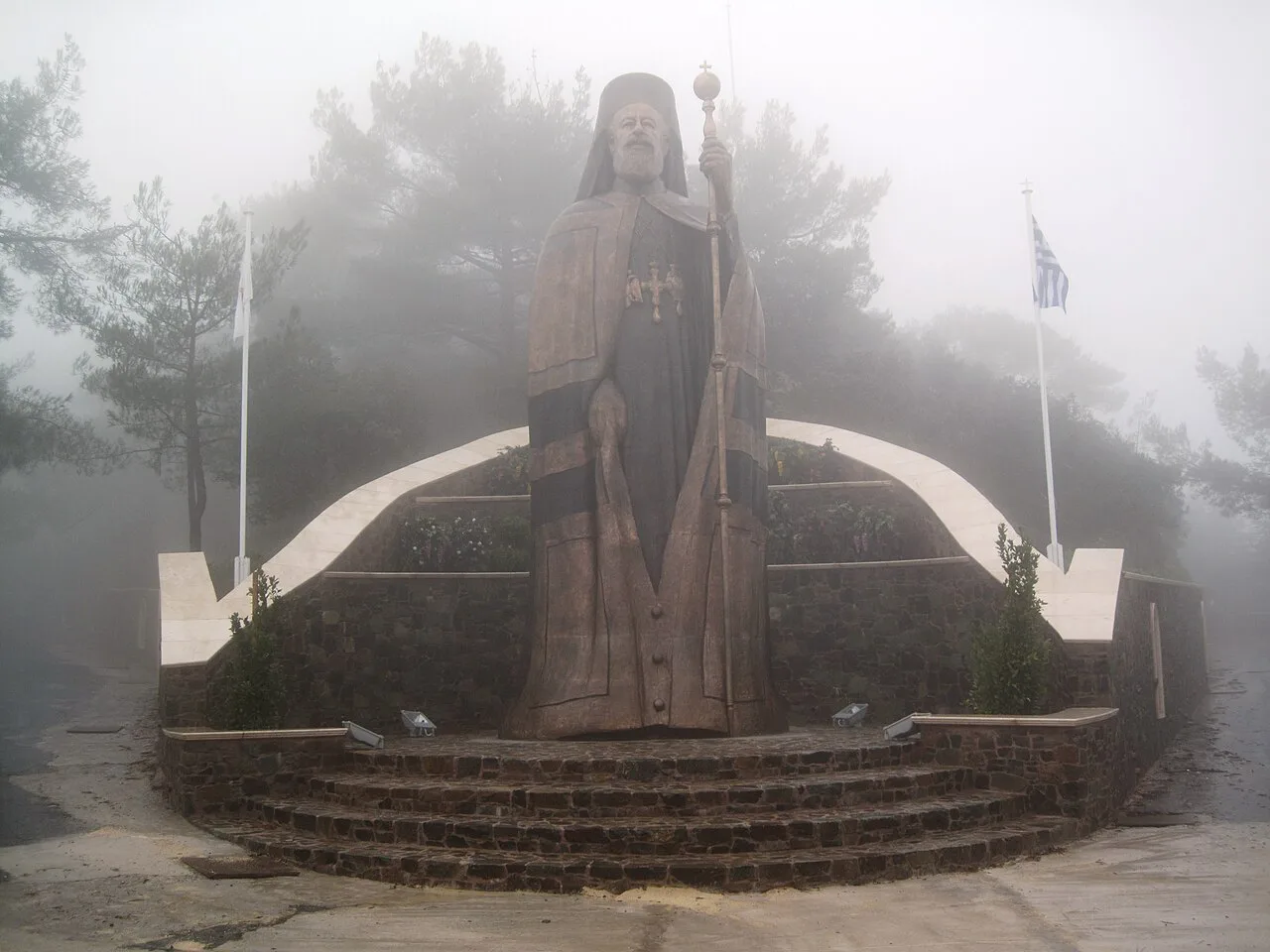
Nearby stands the colossal Bronze statue of Makarios, shown standing and gazing out across the mountains, which gives the site its second focal point. Visitors often merge the tomb and the statue into a single impression, but they are separate pieces: the tomb is the burial place, the statue the memorial figure. Give the site perhaps half an hour to take in the view and walk the path back down.
The memorial and the colossal statue of Makarios III nearby
The larger-than-life statue at the site is a 31-foot (9.5-metre) figure of Makarios created by the Cypriot sculptor Nikolaos Kotziamanis and installed in 1987. It was originally placed in the courtyard of the Archbishopric in Nicosia and was moved to Throni Hill in 2008. Its scale is the opposite of the tomb's modesty, and that contrast is what most visitors remember.
Seeing both in one stop is the reason to climb past the monastery rather than turn back after the courtyard. If you are working through the island's church and monastery sites, the Troodos painted churches guide sets out the UNESCO-listed decorated churches in the same mountain region and helps you judge which detours are worth the road time.
Why the setting above Kykkos shapes the visit
The tomb's significance comes from context as much as architecture: its height above the island, its closeness to Kykkos Monastery, and its place within the pine forest. Makarios spent part of his life at Kykkos from 1926, and the monastery remains the reason most travellers reach this corner of the mountains at all. The setting turns a short stop into something closer to a pilgrimage, whether or not you come for that reason.
The altitude is part of the experience and part of the logistics: cooler air, wind and long views come with the climb. The site's quiet atmosphere is a direct result of its position, well away from the coastal resorts and their crowds. For a sense of how high the range goes, Mount Olympus (Chionistra) is the island's summit and the natural reference point for Troodos elevations.
Visiting alongside Kykkos Monastery: the mosaics, the icon and the courtyard
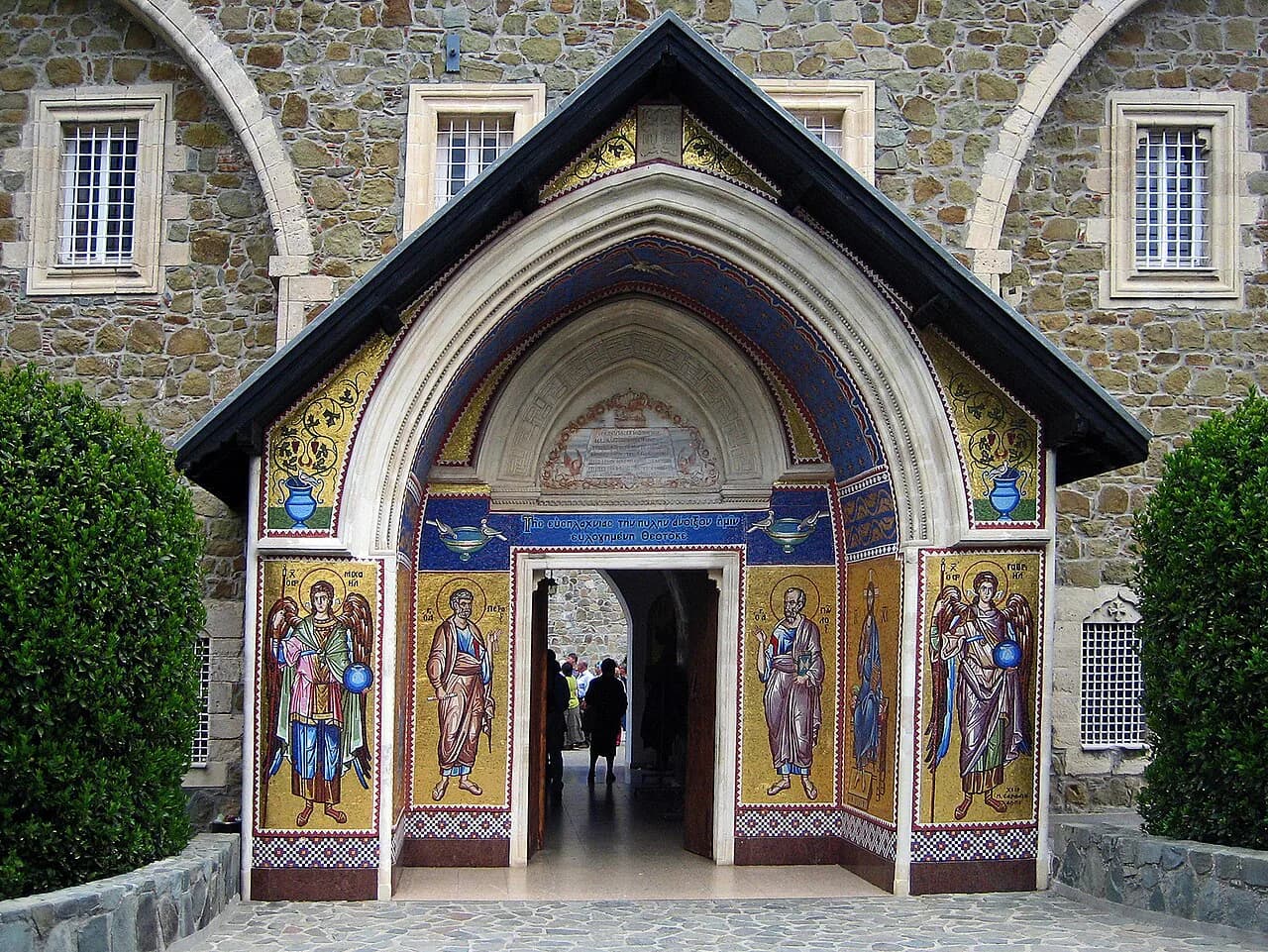
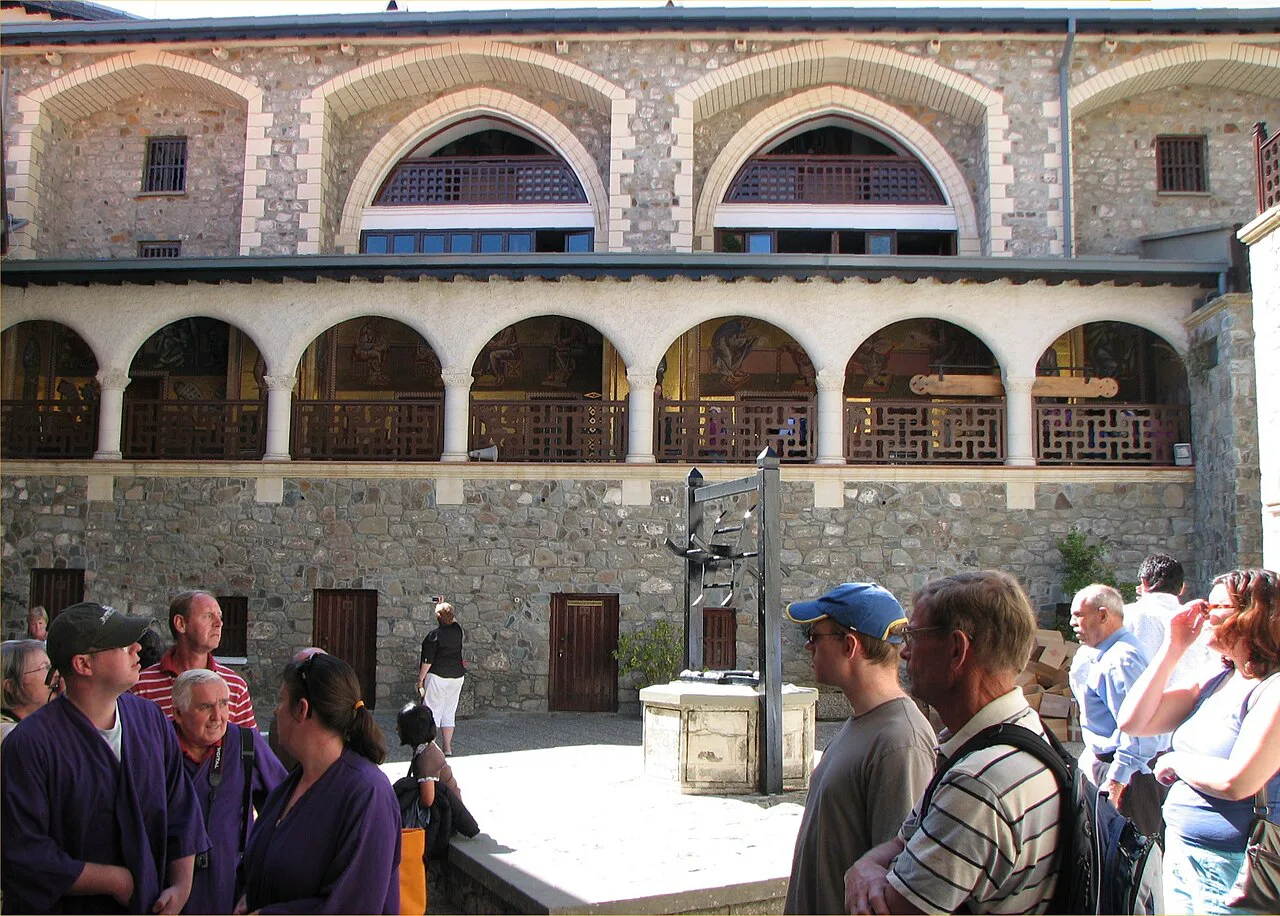
Kykkos Monastery, founded around the end of the 11th century by the Byzantine Emperor Alexios I Komnenos, stands at roughly 1,320 metres and is the most famous Orthodox monastery in Cyprus. Its entrance is grand and welcoming, and the inner courtyard's decorated arcades carry mosaics of scenes such as the Burning Bush, the Good Shepherd, Noah's Ark and Jacob's Ladder. Look up as well as across, because the ceilings are painted in similar richness.
The monastery is dedicated to the Virgin Mary and holds a venerated icon of the Virgin, said to have been painted by the Apostle Luke and covered in gilded silver. It is not displayed to the public, so come for the church interior, the courtyard and the mosaics rather than for a glimpse of the icon itself. Combining the monastery and the tomb means allowing for two separate visits and the drive between them.
Getting around Troodos without a car: practical limits
A car is the realistic way to reach Throni Hill. Village-to-village buses in the Troodos region are limited, and the last stretch to the tomb is a mountain road with no stated public transport service. Without your own vehicle, the monastery and tomb become a taxi or organised excursion rather than a casual stop. The Troodos map shows how the monastery roads relate to the main mountain villages before you commit to a route.
The honest trade-offs: mountain roads, mountain air and the quiet atmosphere
The trade-off is straightforward: the drive is long and winding, the site itself is small, and you will not find cafés, shops or crowds at the top. What you get instead is silence, wind, long horizons and a genuinely contemplative half hour. If you want facilities and a full day of sights, this is a short addition to Kykkos rather than a destination on its own.
Come dressed for mountain air rather than coastal heat, even when the coast is warm, and carry water for the walk up the paved path. The Troodos Geopark guide explains what the mountain's rocks and terrain add to a drive through this landscape.
Who Makarios III was, in the briefest terms
Archbishop Makarios III was the first President of the Republic of Cyprus and, before that, the head of the Cypriot Orthodox Church. His tomb carries both identities: the Orthodox symbolism and the statesman's memorial sit side by side on the hill. The site is a place of national memory as much as a religious one, and that dual character explains why it is visited by pilgrims and sightseers alike.
The statue looks out over the mountains of the region, and the monastery below is where Makarios spent part of his life from 1926. A stop here makes most sense read as a piece of twentieth-century Cypriot history rather than as a monument to admire for its scale.
Where the tomb sits relative to Nicosia and the rest of Troodos
Throni Hill lies deep in the Troodos range, west of Kykkos Monastery and a long mountain drive from Nicosia, the capital where the Archbishopric's courtyard once held the statue. It is not a roadside stop on the way to the coast; it belongs to a day built around the mountains. The best pairing is Kykkos in the morning and the tomb after, when the light opens up the view.
From the Kykkos area you can continue to other mountain sights or return to the coast, but keep the return drive realistic in daylight. The Troodos Attractions: 13 Visitor Guides hub maps the region's main sites and helps you sequence them around a Kykkos and Throni visit.
Should you add Throni Hill to a Kykkos visit?
Yes, if you are already driving to Kykkos Monastery: the tomb is a short continuation up the hill and adds a quiet, memorable half hour to the day. Skip it if your Troodos time is tight or you are relying on buses, because the mountain roads reward a car and patience rather than a rushed schedule. Go for the modest tomb, the colossal statue and the view, in that order of expectation.
Explore more Troodos guides
Frequently Asked Questions
Is the tomb of Makarios III the same as the giant statue?
No. The tomb is the stone burial place under a small domed canopy at the centre of the site, while the colossal statue is a separate memorial figure standing nearby. They are distinct pieces serving different purposes.
Can you see the Kykkos icon when you visit?
The monastery's venerated icon of the Virgin, said to have been painted by the Apostle Luke and covered in gilded silver, remains at Kykkos but is not displayed to the public. The visit centres on the church interior, the courtyard arcades and the mosaics.
Sources
Notes for your Cyprus trip
Optional updates to our Cyprus guides.
You might also like
Continue reading
More guides you'll find useful