Cyprus Monasteries: Kykkos, Machairas and How to Visit
Kykkos and Machairas are the two Cyprus monasteries worth a mountain drive. What you see inside, dress codes, seasonal hours, museum fees and drive times.
On this page
Kykkos Monastery in the Marathasa Valley and Machairas Monastery on Kionia Mountain are the two Cyprus monasteries most worth building a day around. Kykkos gives you a gilded church, a frescoed courtyard and a museum, while Machairas offers a working monastery and the Panayia of Machairas icon. This guide compares what each one actually delivers, sets out the opening patterns and the museum fee, and explains the dress code and the mountain roads that decide how long the trip takes.
Both sit high in the Troodos range and both are free to enter, so the cost of the day is fuel and time rather than tickets, with only the Kykkos museum charging separately. The trade-off is the drive: these are winding mountain roads where distance matters less than the bends, and a coastal base such as Limassol or Nicosia adds a long return leg. Plan one monastery properly rather than cramming both into the same afternoon.
Which Cyprus monasteries are worth the drive: Kykkos and Machairas compared
Choose Kykkos if you want spectacle and a collection: the courtyard arcades, the gold iconostasis and an optional museum make it the fuller half-day. Choose Machairas if you want a quieter, working monastery with a single famous relic and a shorter visit. Kykkos rewards two hours or more if you take the museum; Machairas suits a focused hour or so on the way through the mountains.
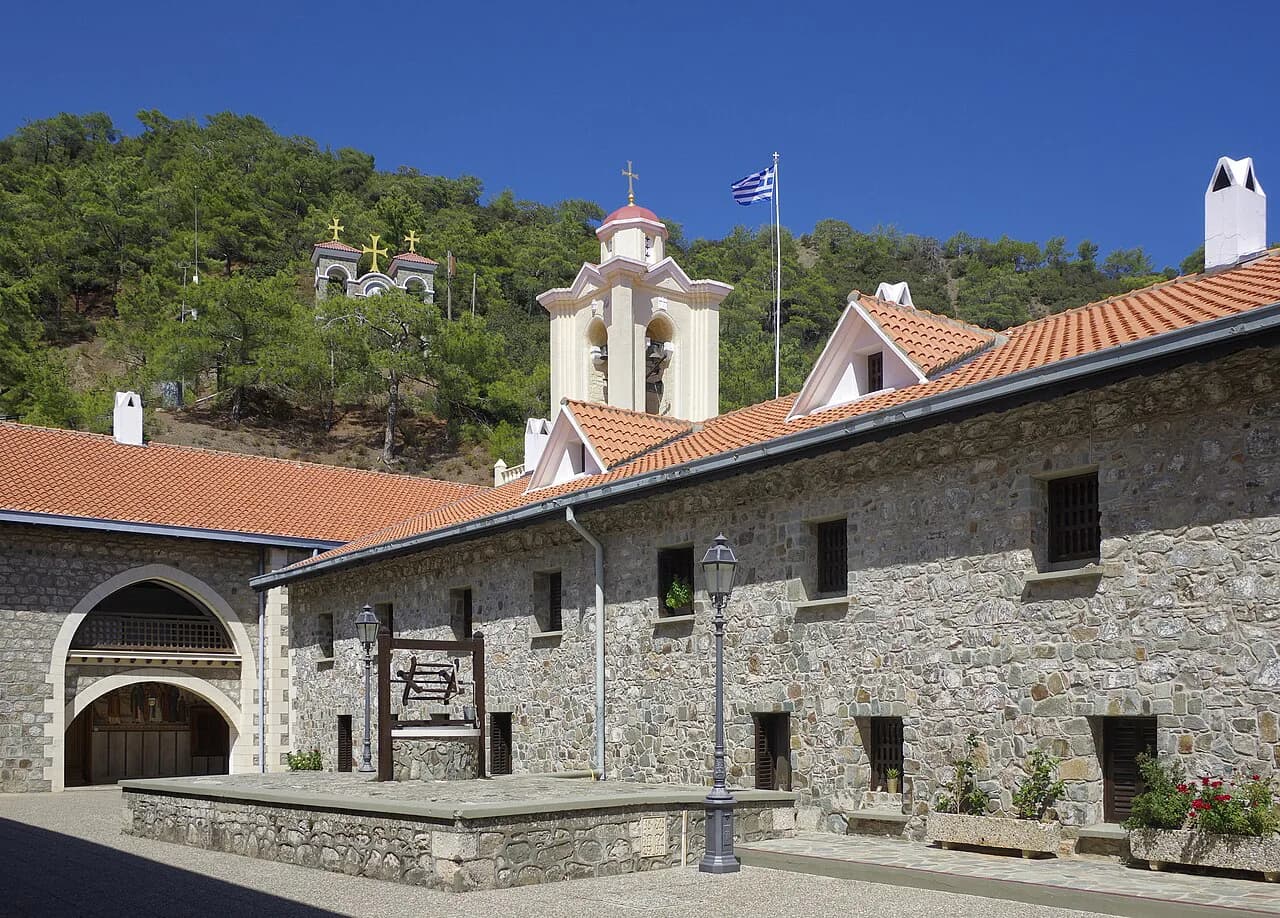
Machairas sits on the slopes of Kionia Mountain, with a rectangular layout and a red-tiled timber roof visible from a distance. Around twenty to thirty Orthodox monks live there, keeping strict vows, and the brotherhood's daily life shapes what visitors can see and where photography is allowed. That working character is the reason to come, so treat the visit as a call on a religious community rather than a museum.
For wider context on the island's religious buildings, including Stavrovouni Monastery and the painted churches of the Troodos, see our guide to Cyprus history. It helps to know which sites are working monasteries and which are preserved monuments before you set out, because the etiquette differs.
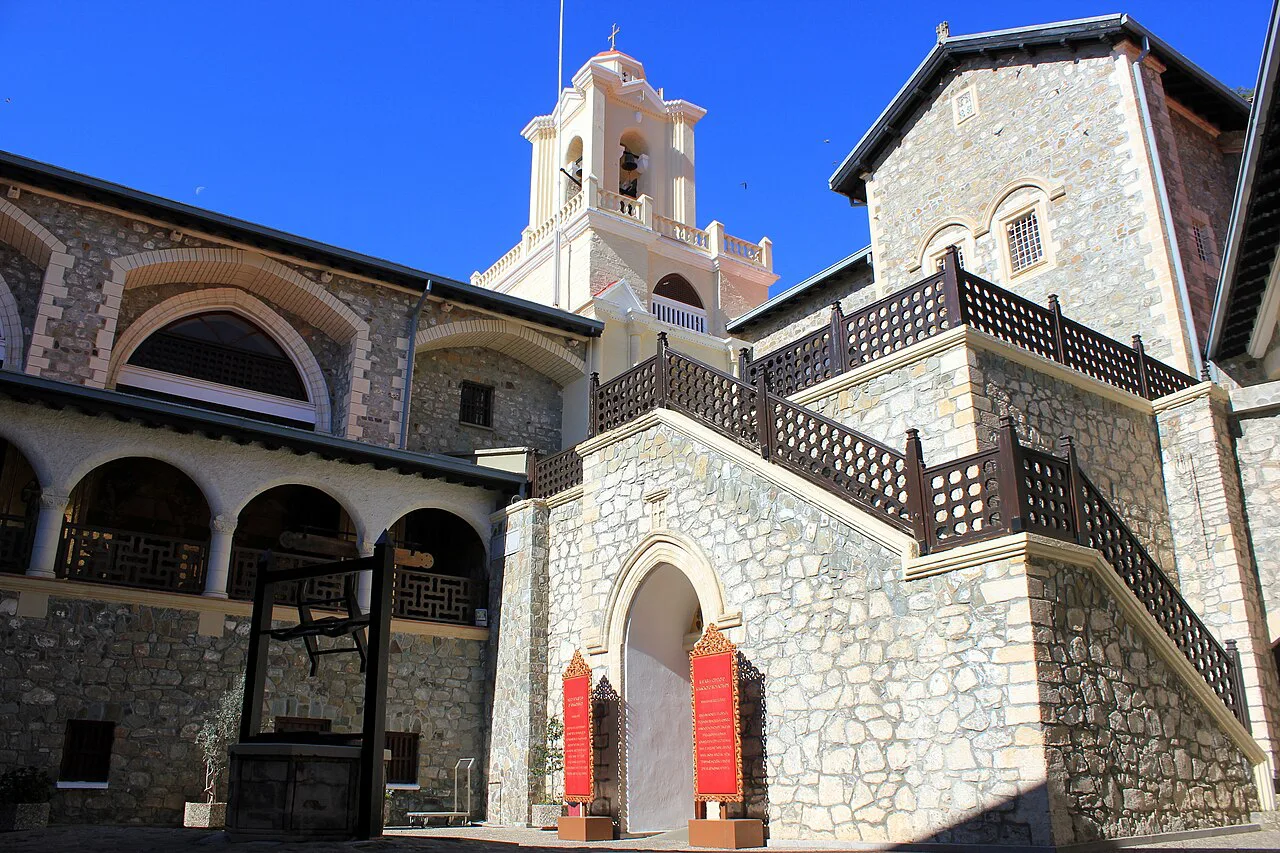
Kykkos Monastery in the Marathasa Valley: what you see inside
Kykkos stands at 1,318 metres in the Marathasa Valley, reached by the F966, and the present complex dates from the nineteenth and twentieth centuries after fires and earthquakes destroyed earlier buildings. The frescoes and mosaics along the monastery corridors were created in 1990 and are the visual highlight of the public areas, running through biblical scenes and vivid compositions. Look up as you cross the courtyard: much of the decoration is above eye level.
Is Kykkos Monastery free to enter? Yes. Entry to the monastery is free, and parking in front of it is free of charge.
What is the dress code for Kykkos Monastery? Kykkos asks men to wear long trousers and women to wear knee-length skirts. Habits can be hired at the entrance if you arrive in shorts.
Is Cyprus Orthodox? Cyprus is predominantly Orthodox Christian, and the monasteries you visit are working religious communities rather than museums. That is why dress codes and photography rules apply, and why you should step aside from anyone praying.
The church holds a gilded iconostasis from 1755 and the silver-plated icon of the Virgin of Kykko, and photography is not allowed inside. People pray there, so keep voices low and move through rather than lingering in the doorway. The incense and gold make it the most memorable interior of the two monasteries.
The museum is separate from the monastery and displays icons, sacred relics and other exhibits; allow at least two hours for the monastery and museum together. If your time is tight, the free courtyard and church already justify the drive, and the museum becomes the optional extra you add when the day has room.
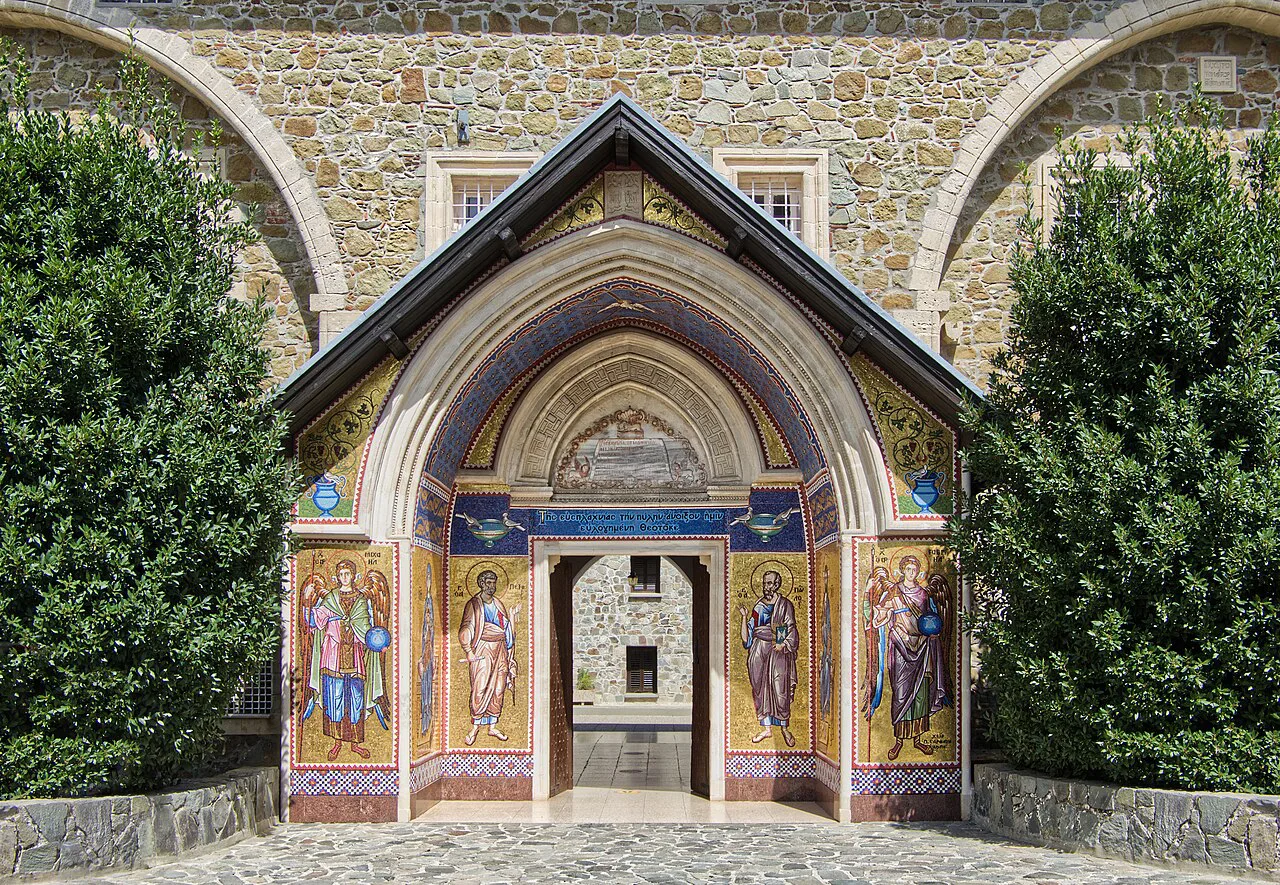
Kykkos practicalities: opening hours by season, free entry, museum fee and parking
The monastery opens from 10:00 to 16:00 between November and May and from 10:00 to 18:00 between June and October, and it closes on public holidays. Entry to the monastery is free, while the museum charges adults five euros. Check the calendar before a mountain day, especially around Greek and Cypriot public holidays when the gates stay shut.
Parking in front of the monastery is free of charge, with several car parks that fill in high season. Arriving at opening time gives you the courtyard before the coaches, and the mountain light is better for the mosaics in the morning.
Machairas Monastery on Kionia Mountain: the icon, the courtyard and the museum collection
Machairas houses the Panayia of Machairas icon, believed to have been painted by the Apostle Luke and brought to Cyprus by a hermit during the Iconoclasm period of the ninth century. The name comes from the Greek word for knife, machairi, after the undergrowth the hermits cut to reach the hidden cave. The icon holds the place of honour inside the church.
The church is built in Byzantine style with a central aisle lined with columns and interiors of icons, chandeliers, stone floors and wall frescoes. Monks' cells and adjacent buildings wrap around it in a rectangle, with the main entrance facing east and a second entrance to the west. Walk the courtyard slowly; the arrangement tells you how the community lives around its church.
The renovated vestry basement, once the monks' cells, stables and storage areas, now holds rare books, manuscripts, icons and religious artefacts. Photography and video are not permitted anywhere on site, so leave the camera in the car and carry a notebook if you want to record names.
Machairas practicalities: opening hours and free entry
Machairas is open daily from 08:30 to 17:30 and entry is free of charge. Confirm the hours the week you travel rather than assuming they hold through every season.
Because Machairas asks nothing at the gate, the cost of the visit is the drive up from the coast and the time you give it. Combine it with a stop in the Machairas Forest rather than treating it as a standalone outing; our Machairas Monastery guide covers the site in more detail.
Dress code and behaviour inside working monasteries
Kykkos enforces a strict dress code: men in long trousers and women in knee-length skirts. Habits are available to hire at the entrance, which solves the problem if you arrive in shorts on a hot day, but hiring takes time and a little dignity. Pack a light long skirt or trousers in the day bag instead.
Inside the churches, keep voices low, do not photograph where signs forbid it, and step aside from anyone praying. Kykkos bans photography in the church, and Machairas bans it across the whole site. Quiet clothing and a scarf for shoulders cover most situations.
Driving to Kykkos and Machairas from the coast: road time and mountain roads
Navigation systems often route to Kykkos by the shortest rather than the fastest mountain roads, which turns a straightforward drive into a slow, scenic one. Set the route yourself toward the F966 through the Marathasa Valley and allow generous time for bends, gradients and the odd wrong turn. Fill up before you climb; fuel stops thin out in the Troodos.
Cyprus drives on the left, and a hire car gives you the flexibility that buses to these mountain sites do not. If you prefer a guided option, tour operators run excursions that combine Kykkos with other monasteries, which removes the driving but fixes your time at each stop.
When to go: season, heat and crowds
The seasonal hours tell you a lot. Winter months shorten the Kykkos day to 10:00 to 16:00, while summer extends it to 18:00, so a summer visit has more slack for a slow drive. Machairas keeps a longer daily window but closes in the late afternoon.
In high season, the car parks at Kykkos get busy and the courtyard fills with groups; in March it was pleasantly quiet. The mountains are cooler than the coast, but the churches are still warm at midday, so go early and save the exposed courtyard for the edges of the day.
Where else monasteries fit into a Cyprus trip
Monasteries pair naturally with the island's other historic sites: castles such as Kantara, Buffavento and St Hilarion in the north, and the castles of Limassol and Paphos in the Republic, all reachable on the same kind of long day out. Our guide to Castles in Cyprus helps you pick which fortification fits the route.
For the region's archaeology and mosaics, including the Paphos Archaeological Park, use the Cyprus archaeological sites guide to build a route around Kykkos or Machairas. The island's museums also carry religious art and icons that make a useful wet-weather complement.
If painted churches are your interest, our guide to Cyprus churches covers the Troodos examples, and the Cyprus museums pages cover icon collections indoors. Allow a full day for a monastery plus one other site, not a rushed three.
Choose Kykkos or Machairas?
Pick Kykkos for the grand interior, the frescoed courtyard and the optional museum, and give it a full half-day with the museum. Pick Machairas for a quiet working monastery, a famous icon and a shorter stop on a mountain drive. Neither charges for entry, so the decision rests on how much time you want to give the road.
Explore more Cyprus guides
Frequently Asked Questions
Is Kykkos Monastery free to enter?
Yes. Entry to the monastery is free, and parking in front of it is free of charge. The museum is separate and carries an adult ticket, so carry cash for that if you intend to visit it.
What is the dress code for Kykkos Monastery?
Kykkos asks men to wear long trousers and women to wear knee-length skirts. Habits can be hired at the entrance if you arrive in shorts. Cover shoulders as well, and keep voices low inside the church, where photography is not allowed.
Is Cyprus Orthodox?
Cyprus is predominantly Orthodox Christian, and the monasteries you visit are working religious communities rather than museums. That is why dress codes and photography rules apply, and why you should step aside from anyone praying. The Church of Cyprus is one of the oldest autocephalous churches in the Orthodox world.
Can you visit Kykkos and Machairas in one day?
It is possible but rushed. Kykkos alone takes two hours or more with the museum, and both sit on winding mountain roads where driving eats the day. Choose one, or split them across two days based from different parts of the island.
Sources
Notes for your Cyprus trip
Optional updates to our Cyprus guides.
You might also like
Continue reading
More guides you'll find useful